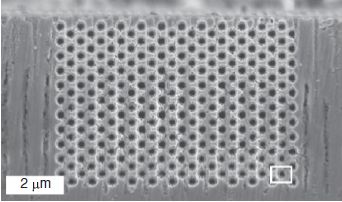
Signature of a three-dimensional photonic band gap observed on silicon inverse woodpile photonic crystals
| Abstract | We have studied the reflectivity of CMOS-compatible three-dimensional silicon inverse woodpile photonic crystals at near-infrared frequencies. Polarization-resolved reflectivity spectra were obtained from two orthogonal crystal surfaces using an objective with a high numerical aperture. The spectra reveal broad peaks with maximum reflectivity of 67% that are independent of the spatial position on the crystals. The spectrally overlapping reflectivity peaks for all directions and polarizations form the signature of a broad photonic bandgap with a relative bandwidth up to 16%. This signature is supported with stopgaps in plane-wave band-structure calculations and with the frequency region of the expected band gap. |
|---|---|
| URL | https://journals.aps.org/prb/abstract/10.1103/PhysRevB.83.205313 |
| Authors | S. R. Huisman, R. V. Nair, L. A. Woldering, M. D. Leistikow, A. P. Mosk, and W. L. Vos |
| Year of publication | 2011 |
| Date published | 05/2011 |
| Journal | Phys. Rev. B |
| Volume | 83 |
| Pages | 205313: 1-7 |
| Keywords | 3D photonic band gap, 3D photonic crystals, 3D silicon photonics, CMOS-compatible |