
Spontaneous Emission Control
Spontaneous emission of light is a well-known quantum phenomenon, where at a random instance in time an excited two-level quantum emitter decays and emits a photon. In the past, several teams of scientists had proposed theoretically that emission of light can be completely controlled in certain nanostructures known as photonic crystals; following work by Bykov in 1972, the 1987 work of Eli Yablonovitch and of Sajeev John is widely known. The latter prediction was the beginning of extensive worldwide research on photonic crystals that are believed to be the basis for future ‘optical integrated circuits’ where information is encoded in light instead of electrons.
COPS researchers were the first ever to show that the time of light emission can be controlled with photonic crystals (see Figure 1). The results have important applications for efficient miniature lasers and LEDs, solar cells and in a longer term for quantum information. By varying the lattice parameter we were able to slow down or speed up the rate of spontaneous emission from the quantum dots. A high emission rate is crucial for novel efficient miniature light emitters such as LEDs and lasers, whereas a low rate could help create solar cells that do not let energy leak away as light.
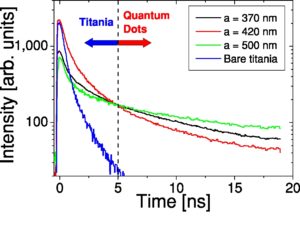
Spatial fluctuations of the local emission rate are rapidly gaining popularity as a gauge for the approach of the Anderson localization phase transition. We have performed the first experimental study of spatial fluctuations of the emission rate inside random photonic media. We measured emission rates of a large number of individual fluorescent nanospheres embedded in a strongly scattering disordered medium. The emission rates were observed to fluctuate spatially, and the variance of the fluctuations increases with the scattering strength, experimentally establishing this important link between scattering and light emission.
Highlighting COPS results
In 2011 we reached a new milestone in photonic crystal research, demonstrating the inhibited emission of quantum dots inside a 3D photonic band gap. We embedded PbS quantum dots, which emit in the near-infrared telecom band, inside 3D silicon photonic crystals. The crystals have a cubic diamond-like inverse woodpile structure and were fabricated with CMOS-compatible methods.
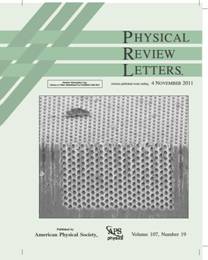
Inside the bandgap the emission is extremely slow, inhibited by at least a factor 10. New analysis methods had to be developed to extract such slow decays from our data. Click on the cover at left to navigate to the PRL publication.