Plasmonic Nanocrystal Arrays on Photonic Crystals with Tailored Optical Resonances
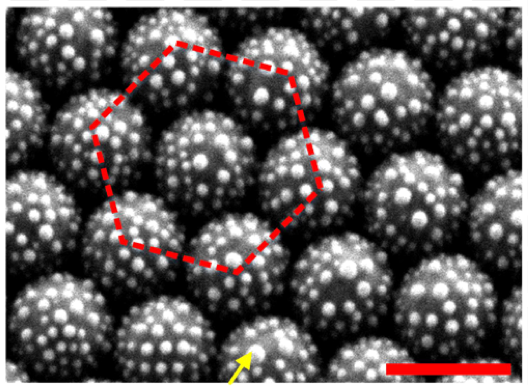
| Abstract | Hierarchical plasmonic−photonic microspheres (PPMs) with high controllability in their structures and optical properties have been explored toward surface-enhanced Raman spectroscopy. The PPMs consist of gold nanocrystal (AuNC) arrays (3rd-tier) anchored on a hexagonal nanopattern (2nd-tier) assembled from silica nanoparticles (SiO2NPs) where the uniform microsphere backbone is termed the 1st-tier. The PPMs sustain both photonic stop band (PSB) properties, resulting from periodic SiO2NP arrangements of the 2nd-tier, and a surface plasmon resonance (SPR), resulting from AuNC arrays of the 3rd-tier. Thanks to the synergistic effects of the photonic crystal (PC) structure and the AuNC array, the electromagnetic (EM) field in such a multiscale composite structure can tremendously be enhanced at certain wavelengths. These effects are demonstrated by experimentally evaluating the Raman enhancement of benzenethiol (BT) as a probe molecule and are confirmed via numerical simulations. We achieve a maximum SERS enhancement factor of up to ∼108 when the resonances are tailored to coincide with the excitation wavelength by suitable structural modifications. |
|---|---|
| URL | |
| Authors | J. Wang, H. Le-The, T. Karamanos, R. N.S. Suryadharma, A. van den Berg, P. W. H. Pinkse, C. Rockstuhl, L. Shui, J. C. T. Eijkel, and L. I. Segerink |
| Year of publication | 2020 |
| Date published | 07/2020 |
| Journal | ACS Appl. Mater. Interfaces |
| Volume | 12 |
| Pages | 37657−37669 |
| DOI number | 10.1021/acsami.0c05596 |
| Keywords | localized surface plasmon resonance, photonic stop band, plasmonic−photonic microsphere, slow light effect, surface-enhanced Raman spectroscopy |