Position-dependent optical energy density measured in 3D scattering samples (new PRA by Ozan Akdemir et al)

When light enters opaque white materials like paint, foam, or tissue, the photons are scattered like pinballs. So light doesn’t “happily” move about as in free space around us, but it’s paths are thoroughly folded up. In physics, this is also known as a random walk or drunkard’s walk (for a very inebriated person leaving the bar and at every next step forgetting what his previous step was…)
A central question is then: if light is so folded, how is energy of the light spread?
Previously, COPS had studied the theory on how light energy spreads in space, and found that several major models (e.g. diffusion) fail miserably, as in: a negative energy density, so ouch that’s unphysical. (Click: previous theory paper) So as `hard-core’ experimentalists, Ozan and his colleagues said to each other: how about if we try to measure the energy density?
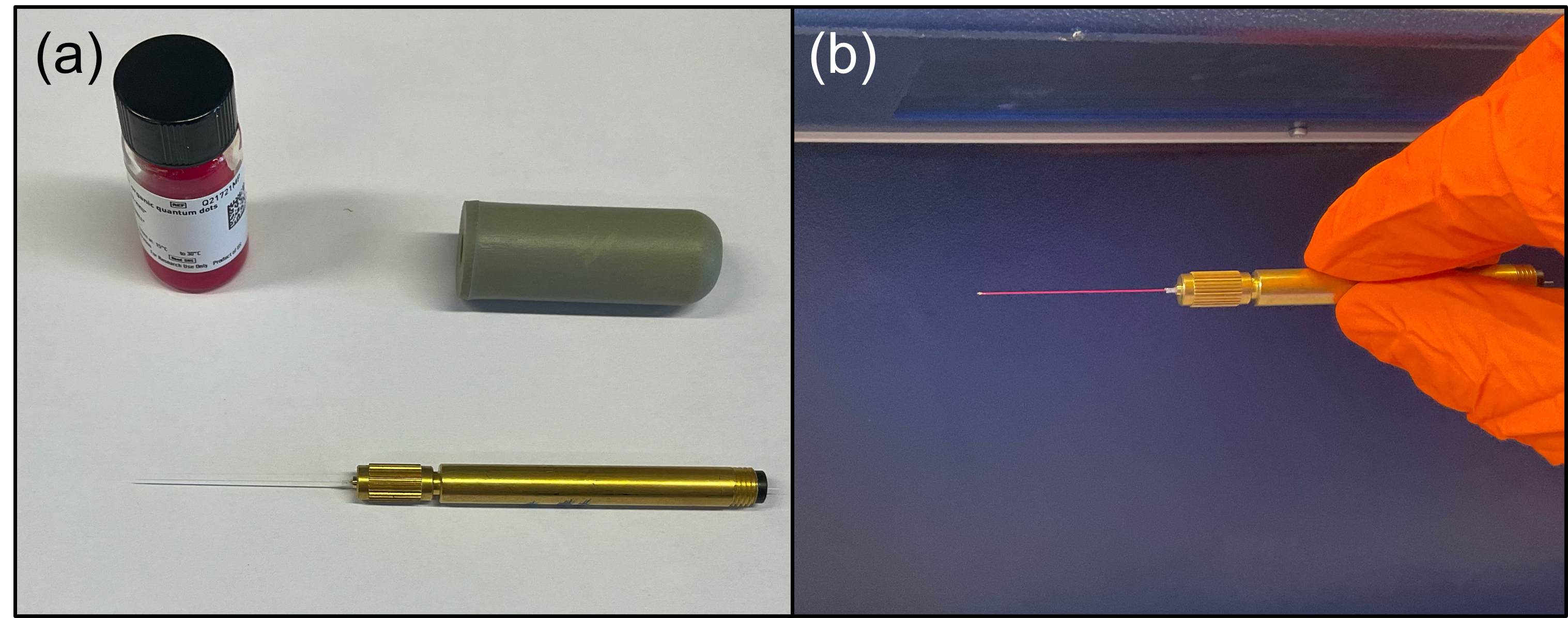
First author Ozan Akdemir explains: “We set out to measure the energy density of blue light by having the light excite semiconductor quantum dot nanoparticles that emit red light. So the quantum dots report the blue energy density. The photo shows the delicate probe full of red quantum dots.”

After a lot of ghost busting (bug hunting) the team found that the measured energy density(*) matches beautifully with (sorry it gets technical) the “P3 approximation to the radiative transfer equation (well-known in climate science!) with an Eddington correction for forward scattering”. Senior authors Willem Vos and Ad Lagendijk are ebullient: “The upshot is that one model works well which makes it straightforward to calculate the energy density of light! So sorry BigTech, no big computers, no AI, no ML warranted, just a few mathematical equations. This is really convenient whenever you want to know the energy density of light!”
Needless to say: the team didn’t manage to see the predicted negative energy densities. They really regretted this, as they were really in the mood for some cool wormhole surfing, funky time travel and other fun physics. (This is of course a joke 😉
The naive question is of course: what is this really good for? You’ll be amazed, dear Reader, there are lots and lots of applications that depend on the energy density. Accurate observations as reported here are indispensable for device applications in, for instance, semiconductor metrology, solid-state lighting, and space observation optics, all of which are actual applications of the COPS-led research program Freeform scattering optics (FFSO).
The new COPS paper entitled “Probing the position-dependent optical energy fluence rate in three-dimensional scattering samples” has just been published in the well-known refereed scholarly journal Physical Review A, which is published by the world’s prime learned society, the American Physical Society (APS). See also: https://nano-cops.com/publications/article/probing-the-position-dependent-optical-energy-fluence-rate-in-3d-scattering-samples/
(*) Strictly speaking, the team measured the optical energy fluence rate (proportional to the energy density), but this is a fine point for “urban gourmandizers”.