Classifying the Confinement of Photons in Photonic Structures by Machine Learning

Suppose you have invented or even made a new and typically complex photonic crystal in which you would like to confine the photons in some nifty way. Chances are that in addition to the confinement you originally had in mind, there are multiple other ways in which light is confined, or half-confined, or quasi-confined, etc. How to classify such confinement, and even more, could the confinement please be done automatically and not “by hand”?
This is in (highly!) simplified terms the topic of the recent paper “Unsupervised machine learning to classify the confinement of waves in periodic superstructures” by COPS scientists Marek Kozoň and Willem Vos in close collaboration with MSc student Rutger Schrijver, and mathematicians Matthias Schlottbom and Jaap van der Vegt from the MACS chair in the Electrical Engineering and Mathematics Department, see link.
The team proposes a rigorous method to classify the dimensionality of wave confinement by using unsupervised machine learning to enhance the accuracy of our recently presented scaling method [Kozon-et-al-PRL]. They applied the standard k-means++ algorithm as well as their own model-based algorithm to 3D superlattices of resonant cavities embedded in a 3D inverse woodpile photonic band gap crystal [see: Adhikary-et-al-Observing-Cartesian-light] with a range of design parameters. In such an advanced photonic system, photons can be made to “hop” between resonant cavities that are positioned on a 3D crystal lattice. But the photons could also be guided in certain directions, or show other wave propagation modes, all of which the team wants to distinguish.
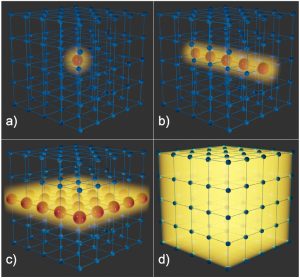 Illustration of 3D supercells with various superstructure to confine photons. Blue spheres are unperturbed unit cells, red spheres to modified unit cells and confined light is shown in yellow. (a) Supercell with a single cavity with confinement dimensionality =3. (b) Supercell with a line defect with confinement dimensionality =2. (c) Supercell with a plane defect with confinement dimensionality =1. (d) A supercell without defects and all unit cells identical does not support confined waves, hence =0.
The team compared their different results against each other and against the direct use of their new scaling method (without clustering). Since the clustering algorithms require the set of confinement dimensionalities present in the system as input, they investigated cluster validity indices (CVIs) as a means to find these values. The team concluded that the most accurate outcome is obtained by first applying direct scaling to find the correct set of confinement dimensionalities, and subsequently utilizing their model-based clustering algorithm to refine the results.
Using their new method, the team is currently designing better nanostructures made from silicon, that will in future shuttle information encoded as photons in a controlled way through 3D “chips” that thus allow more capacity in a smaller footprint, with potential applications in more sustainable portable communication devices.