Finding a needle in a haystack

Tracking the position of a single particle within opaque samples, such as paint, foam, and tissue, is a major challenge in optics. The difficulty of this challenge is comparable to finding a needle in a haystack, but in this case, the needle has the same physics as the straw. A team of researchers from the University of Twente responded to this challenge by manipulating multiple beams of light sent to the opaque sample and taking advantage of a phenomenon known as “mutual scattering”. But how exactly can scientists detect the position of a single nano-scatterer in the middle of a forest of other objects? And what is the novelty of the technique of using multiple incident rays compared to traditional techniques with a single beam? The answers can be found in the latest COPS scientific paper in Optics Express published by Optica.
The traditional way to study a sample is to send a single beam of waves to the target and study the scattered waves, as in typical X-ray experiments for weakly interacting samples. However, if a medium becomes increasingly opaque, i.e. interacts more strongly with the waves, this single scattering approaches start breaking down as we mostly detect only wave interference, i.e. speckle pattern. The recent development of multiple-beam techniques, such as optical wavefront shaping invented in COPS in 2007, where light scattering with multiple properly phased incident beams, has opened new potential for research of strongly interacting opaque samples. Among them, an interesting phenomenon of multi-beam is called “mutual scattering”, derived from the cross-interference of different incident beams.
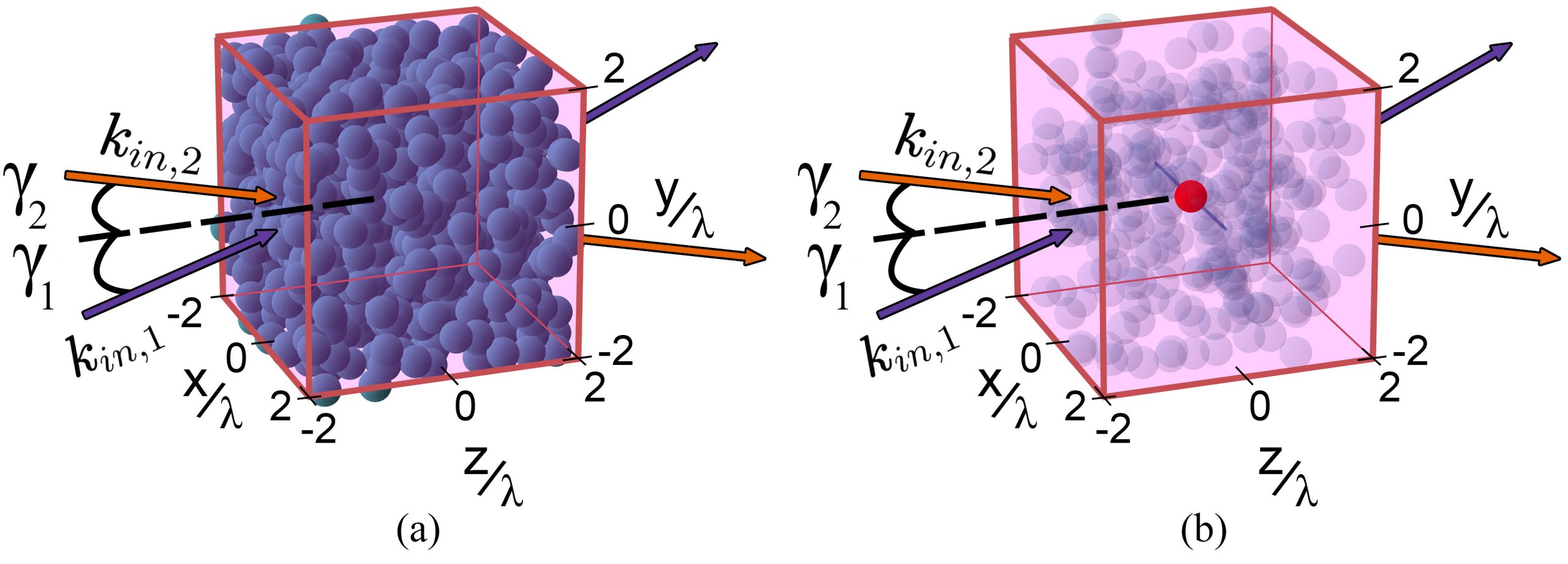
The question that arises is whether the “mutual scattering” can bring us any advantage to detect the displacement of a single nanoparticle deep inside a sample with an ensemble of many (up to 1000) similar nanoparticles (see figure 1), where the nanoparticle we wish to track is not a tracer particle with properties different from the ensemble, like a dyed nanosphere standing out in a sea of undyed ones. The answer is Yes: In their recent paper, scientists from COPS demonstrate with their numerical simulations that mutual scattering provides speckle patterns with an angular sensitivity at least 10 times higher than the traditional one-beam techniques. As Minh Duy Truong, the first author of the paper, explains: “The underlying hypothesis is that the cross-interference of multiple beams is more sensitive to changes of a scatterer located deep within the sample than conventional one-beam methods”, “By studying the susceptivity of mutual scattering, we demonstrate the possibility to determine the original depth relative to the incident surface of the displaced dipole in an opaque sample”.

Figure 1: Schematic of the numerical samples:
(a) A cube with N=1000 dipoles, and (b) a cube with N=250 dipoles, whose polarizability is shown by the extent of the blue spheres. The target dipole (red sphere) at position is moved along a chosen direction, for example, the blue line shows the movement of the red scatterer in the x-direction, while the positions of all other scatterers are preserved.

Figure 2: Comparison in a semi-log scale between (top) the mutual scattering from two beams and (bottom) the differential cross-section from one beam. The blue zones show how the maximum mutual scattering and the differential cross-section vary as the configurations of the dipoles are changed.
Support
The research was done in the Complex Photonics Systems group (COPS), part of UT’s MESA+ Institute. The work is part of the ongoing NWO-TTW Perspectief program “Free-form Scattering Optics” (FFSO), a collaboration in applied sciences and technology with TU Eindhoven and TU Delft, with the participation of users from leading industries ASML, Lumileds, Signify, TNO, Demcon, Schott.
Paper
The paper ‘Sensing the position of a single scatterer in an opaque medium by mutual scattering’, by Minh Duy Truong, Ad Lagendijk, Willem L. Vos, DOI:10.48550/arXiv.2211.16924. COPS is also proud to announce that the data used for the publication is available in the Zenodo database with DOI:10.5281/zenodo.7362231
Further contact
Minh Duy Truong, email = m.d.truong@utwente.nl
Prof. Willem Vos, telephone = 053 – 4895388 or 053 – 4895390 (secretariat), email = w.l.vos@utwente.nl