Controllable steering of light by a single nanoparticle

Light scattered by nanoparticles is at the basis of the rich colors of stained glass in medieval buildings or of the sky at sundawn and sunset, and is widely exploited for high-tech applications like the fabrication of integrated circuits. The shape and size of a nanoparticle completely determine the outgoing directions of the scattered light, that are also called outgoing channels. Previously, it was considered to be impossible for a single nanoparticle to sustain multiple scattering channels. But recently, an international research team from China and the Netherlands has realized that a single nanoparticle does sustain multiple channels. By using an ingenious method – optical wavefront shaping – one can even dial combinations of the channels to control the directionality and color of the scattered light. Dialing these channels at will is analogous to how one selects a TV channel to watch a favorite show. The results appear in the leading journal Physical Review A published by the American Physical Society.
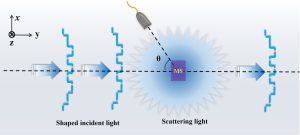 FIG. 1. Light waves incident from the left onto a scattering particle (MS) are scattered in all directions. When the incident light has a specially shaped wavefront, scattered waves obtain controllable properties in directionality and color, that are seen by a detector as shown at an angle theta.
This study concerns light scattering of dielectric nanoparticles that are building blocks of modern functional nano devices, like the chips in our mobile phones. Previous studies mainly focused on designing the shape and size of a nanoparticle, and considered the situation where only a single plane wave is incident on a nanoparticle. “In our work, we decided to consider multiple incident light waves, since this has recently become feasible. By employing a so-called scattering matrix analysis, we discovered that a single nanoparticle sustains remarkably multiple strongly scattering eigenchannels,” explains lead author Peilong Hong. He continues: “These scattering eigenchannels can be selectively activated by controlling the wavefront of incident light,” as illustrated in Figure 1. Second author Willem Vos enthuses: “It is amazing that by shaping the incident waves, we can literally steer the outgoing light. Ever since my group pioneered optical wavefront shaping, it is being used all over the world to control light that is propagating through opaque materials that consist of many nanoparticles. These materials are known to have many scattering paths among different nanoparticles, which leads to the multiple scattering channels. And naively, we thought that a single particle had only one channel. So the realization that a single nanoparticle has multiple channels was amazing.”
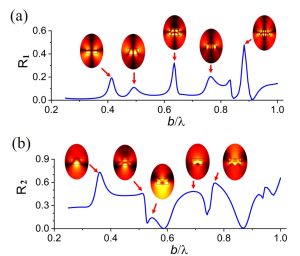 FIG. 2. Light intensity scattered in backward directions (see Fig. 1) plotted against the incident color of light. (a) When the incident wavefront has the shape of the first eigenchannel at b/lambda = 0.6, a peak appears nearby as well as peaks at other colors. (b) When the incident wavefront has the shape of the second eigenchannel at b/lambda = 0.6, a new pattern arises with a trough at 0.6, a broad peak at higher b/lambda, and additional peaks and valleys. At every peak we show the light wave patterns inside and near the nanoparticle. “Hot spots” appear where the light is remarkably enhanced.
In their study, the authors send light into selected scattering eigenchannel and find tightly localized “hot spots” in the light field patterns shown in Figure 2, where the light is strongly enhanced. “This result means that we can actively control light-matter interactions with a nanoparticle by selectively exciting a channel. Or we can control the interference between different channels, which is useful in applications such as fluorescence (for biology), tiny efficient lasers, and nonlinear harmonic generation for versatile light sources,” says Peilong Hong. “We find that the spectra of different scattering eigenchannels are quite different,” says Willem Vos, “It is fantastic that one can effectively change the appearance of a single nanoparticle just by controlling the wavefront of incident light, a bit like how a chameleon alters its skin color when stimulated by different surroundings.”
The team consists of Dr. Peilong Hong and Prof. Willem Vos. Dr. Peilong Hong is a faculty member in the School of Optoelectronic Science and Engineering at University of Electronic Science and Technology of China (UESTC). Willem Vos is from the Complex Photonic Systems (COPS) chair of the MESA+ Institute for Nanotechnology at the University of Twente, the Netherlands. Hong acknowledges support from the Natural Science Foundation of Sichuan Province (23NSFSC0415), the Fundamental Research Funds for the Central Universities (ZYGX2020J010), and the Open Project Funding of the MOE Key Laboratory of Weak-Light Nonlinear Photonics (OS22-1). Vos acknowledges support by the NWO-TTW program P15-36 “Free-form scattering optics” (FFSO, in collaboration with TUE, TUD, and ASML, Demcon, Lumileds, Schott, Signify, TNO), NWO program “Photonic band gaps in quasi-crystals” (PI: Alfons van Blaaderen), and the MESA+ Institute section Applied Nanophotonics (ANP).
The paper is entitled “Controlled light scattering of a single nanoparticle by wavefront shaping” and is being published in Physical Review A, a prominent physics journal published by the American Physical Society (APS). Link: https://doi.org/10.1103/PhysRevA.106.063502 A copy of the paper is also available on the COPS website at: https://nano-cops.com/publications/article/controlled-light-scattering-of-a-single-nanoparticle-by-wavefront-shaping/ It is also available on the Cornell preprint server Arxiv: https://doi.org/10.48550/arXiv.2204.08264
Contact the authors: Peilong Hong can be reached at email plhong@uestc.edu.cn. Willem Vos can be reached at email w.l.vos@utwente.nl, or by phone at +31-(0)53 4895388.