Ultrafast switching of quantum dot emission in micropillar cavities: New COPS paper in Nature’s “Light Science & Applications” with Grenoble and Rio de Janeiro colleagues

In close collaboration with colleagues and friends from the Université Grenoble Alpes in France and the Pontifícia Universidade Católica do Rio de Janeiro in Brazil, we recently published a review in the Nature journal “Light: Science & Applications” on the (extremely) rapid switching of optical resonators by short pulses of light.
The resonators are tiny micropillars with dimensions of a few microns that confine light, made from semiconductors by the Grenoble team. We have even grown quantum dots inside the pillars, that are fast and efficient emitters of light. By focusing short laser pulses on the micropillars, we induce ultrafast switching behavior as fast as 1.5 picoseconds (one picosecond or ps, is one millionth of one millionth seconds). And “switching” means that the resonators effectively “change color”, first become a bit bluer and then quickly reddening back to their original resonance.
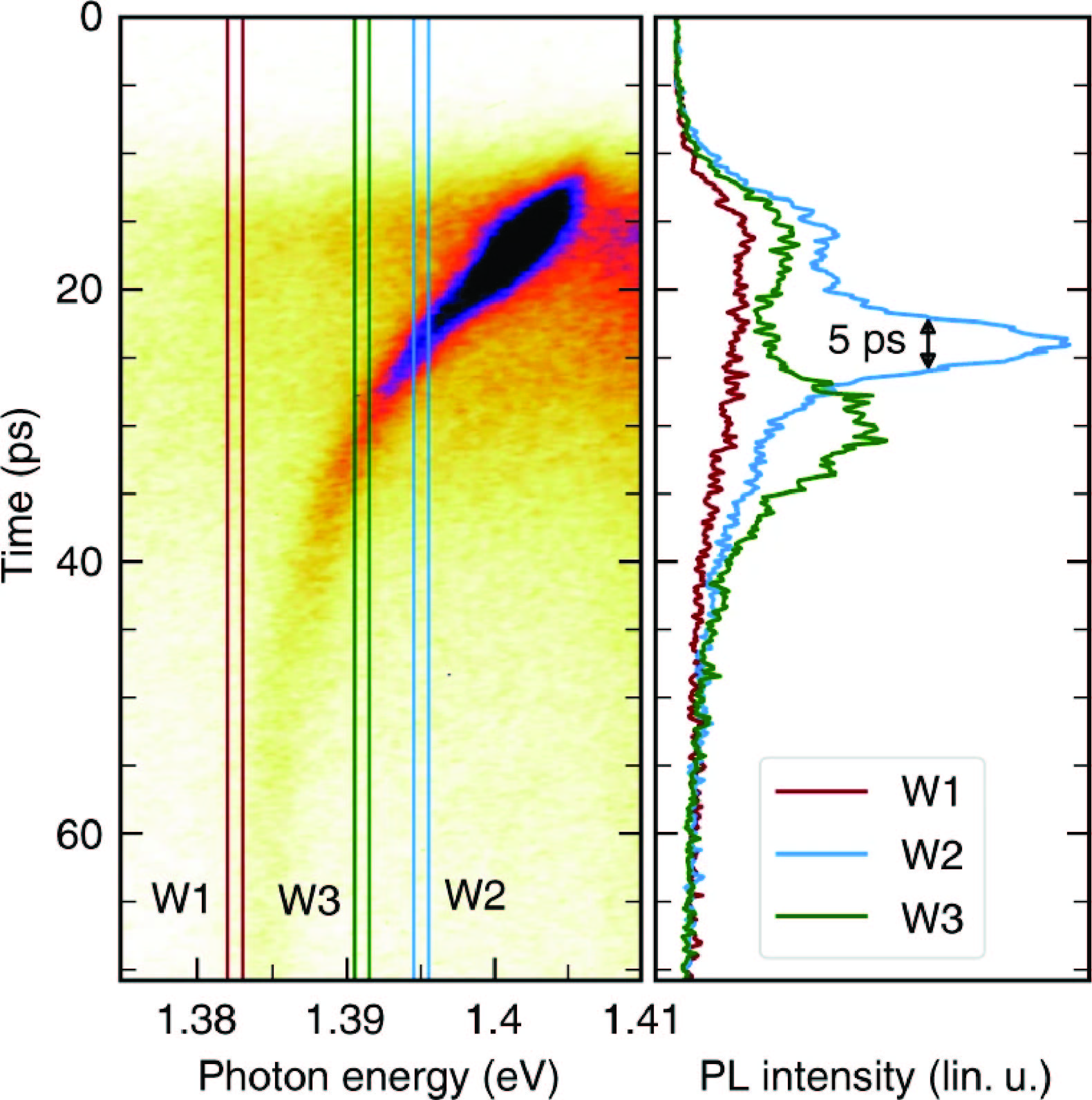
By observing the light emitted by the quantum dot light sources with an extremely fast camera (a so-called streak camera), allows us to analyze the dynamics of both the light and the quantum dots. For instance, we report the generation of ultrashort spontaneous emission pulses (as short as 6 ps), see Figure 1.
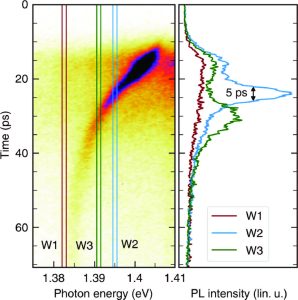 Figure 1: Streak camera image of an ultrashort – few ps – light pulse by quantum dots in a switched micropillar (with Q=2000). W1-3 are windows just below (W1) or above (W2-3) the unswitched resonance at 1.384 eV.
These pulses display a very small so-called coherence length, which may be attractive for ultrafast imaging, if one wants to avoid the graininess (called “speckle”) usually associated with laser illumination. Moreover, the fast control of interaction between the quantum dot and the light in the resonator is an appealing resource for the new field of quantum photonics, that is fast growing for its exciting opportunities in the popular field of quantum information processing, see Figure 2.
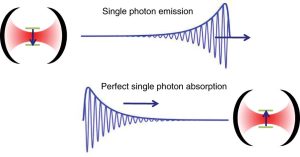 Figure 2: (Top) An emitter in a static cavity emits a single photon with an asymetric shape in time. (Bottom) Perfect single photon absorption by the emitter requires the single photon to have a reversed shape.
If you’re curious to learn more, here is the link to the paper on COPS web (click!) and here the bibliography: Light: Science & Applications volume 10, Article number: 215 (2021)
We thank colleagues Emanuel Peinke, Tobias Sattler, Guilherme Torelly, Patricia Souza, Sylvain Perret, Joël Bleuse, Julien Claudon, and Jean-Michel Gérard for the great collaboration. COPS is grateful for support by the NWO-FOM “Zap!” project, and support by NWO, NWO-Nano, and NWO-TTW, espec. the ongoing TTW Perspectief program “Free-form scattering optics” (FFSO). We also applaud the heroes in earlier ultrafast switching adventures, Georgios Ctistis, Tijmen Euser, Philip Harding, Alex Hartsuiker, Patrick Johnson, Femius Koenderink, Adriaan Molenaar, Henri Thyrrestrup, Emre Yüce. And above all the great Henry van Driel for his kind encouragements early on.