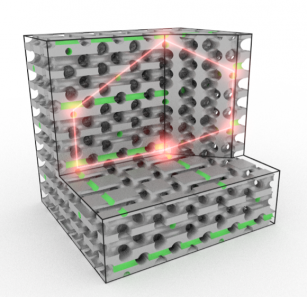
Light proceeds by jumps on a lattice in new 3D photonic nanostructures

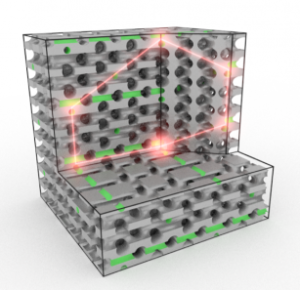
In everyday life, light is out of control. A light bulb illuminates a room in all directions simultaneously, sr. of solid angle. Restricting the light to propagate in a few directions only would enable new opportunities both for fundamental physics and technology.
An interdisciplinary team of physicists and mathematicians from the University of Twente has now performed advanced calculations on a very promising nanostructure developed in the Complex Photonic Systems group. “We studied 3D cavity superlattices inside 3D photonic crystals”, says PhD Sjoerd Hack. “A 3D cavity superlattice is like a chessboard. Light is forced to propagate by a series of jumps between adjacent sites.”
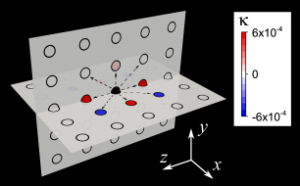
The researchers employed a sophisticated tight-binding model and large-scale calculations on a computer cluster. “We found that light jumps in a few directions only which was unexpected from the dispersion of the superlattice”, Sjoerd says. “We anticipate that the present study may form the basis for further study exploration of nanophotonic phase transitions. Such a study would proceed by introducing controlled degrees of disorder in the cavity resonance frequencies. We are all familiar with phase transitions such as the boiling of water. In nanophotonic cavity superlattices, we expect a phase transition to occur between a state where light is propagating, and a state where light is trapped because it is moving in loops on the lattice.”
In a concurrent paper in Physical Review B, the group demonstrates that the cavities act as 3D cages for light by exploiting a surrounding photonic band gap crystal nanostructure as the 3D jail’s bars, see https://nano-cops.com/publications/three-dimensional-photonic-band-gap-cavity-finite-support-enhanced-energy-density-and-o. Such 3D confinement of photons is essential for efficient miniature lasers and LEDs, on-chip storage of bits of information, and even sensitive sensors for the life sciences. The group expects that the cavities will find applications in quantum photonic integrated circuits (PICs) such as the recent spin-off Quix (“the fastest way to a quantum future“), see www.laserfocusworld.com/articles/2019/01/new-dutch-silicon-nitride-photonics-company-quix-aims-at-quantum-computing.html.
The team:
The research has been performed by Sjoerd Hack M.Sc., Prof. Dr. Jaap van der Vegt and Prof. Dr. Willem Vos from the Complex Photonic Systems (COPS) Chair, MESA+ Institute for Nanotechnology, University of Twente, The Netherlands and Mathematics of Computational Science (MACS), MESA+ Institute for Nanotechnology, University of Twente, The Netherlands. The research project is supported by the 4TU federation.
Further information can be obtained from:
Sjoerd Hack M.Sc., email: s.a.hack@utwente.nl phone: +31-6-22166081.
Prof. Dr. Willem Vos, email: w.l.vos@utwente.nl phone: +31-53-489-5388.
Information on the world wide web:
The paper is entitled “”Cartesian light”: unconventional propagation of light in a 3D superlattice of coupled cavities within a 3D photonic band gap” and has been published in Physical Review B on 12 March 2019 (Phys. Rev. B 99, 115308 (2019)) and is available at https://journals.aps.org/prb/abstract/10.1103/PhysRevB.99.115308