Abstract

In this PhD Thesis, we theoretically and numerically investigate novel aspects of light propagation in three-dimensional (3D) photonic band gap crystals that open up new opportunities to tune the interaction between light and matter. We also develop highly accurate non-reflecting boundary conditions for a mixed DG discretization of the Maxwell equations on finite size computational domains.
Photonic crystals are a class of nanostructures with a periodically varying refractive index in space. Three-dimensional photonic crystals can have a 3D photonic band gap: due to wave interference, light is not allowed to exist within the crystal. A 3D band gap offers new opportunities to tailor the interaction between light and matter.
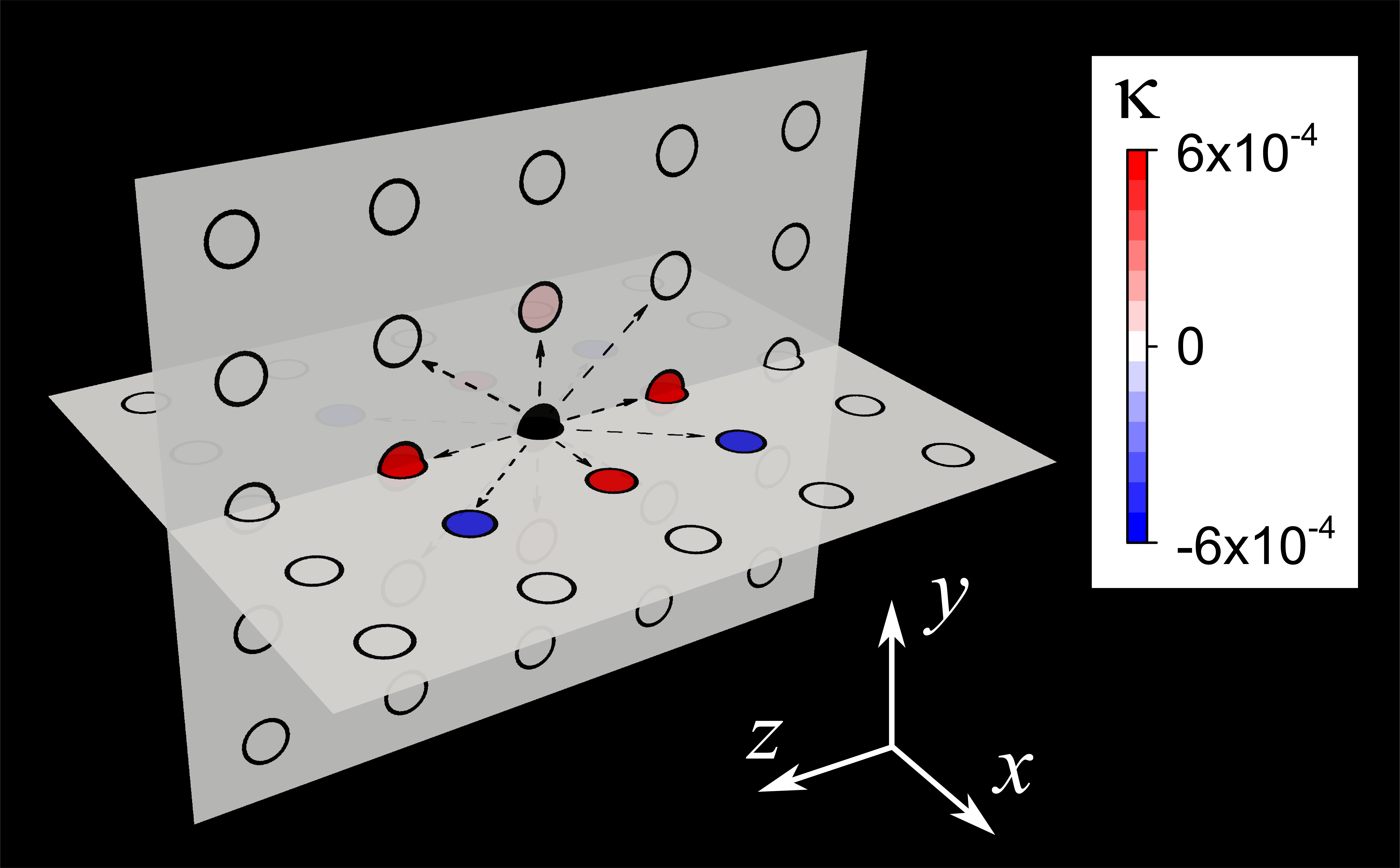
We explore for the first time the propagation of light in a 3D cavity superlattice inside a 3D photonic band gap crystal. Each cavity acts as a "cage" for light due to the surrounding band gap. In a superlattice with closely spaced cavities, the light sometimes "escapes" and hops to one of the neighboring cavities. We calculate the coupling coefficients that describe the hopping transport. We observe for one of the modes of light propagation that light hops only in the Cartesian directions. This cannot be readily inferred from radiation patterns, due to higher-dimensional wave interference. We also study time-resolved propagation patterns in a 3D cavity superlattice, and the effects of disorder on the density of states (DOS) in 3D photonic band gap crystals.
Mixed discontinuous Galerkin (DG) finite element methods are well suited to solve the Maxwell equations in complex structures, as they allow to efficiently capture singularities at dielectric corners and interfaces and also provide a spectrum of electric field solutions that is free of spurious modes.
In this PhD Thesis, we combine a mixed DG discretization with non-reflecting boundary conditions. The boundary conditions are obtained by applying the well-known Hagstrom-Warburton non-reflecting boundary conditions separately to the tangential components of the electric field. The discretized Hagstrom-Warburton boundary conditions successfully describe unboundedness with only small spurious reflections that are accurately predicted by an estimate. These new non-reflecting boundary conditions will allow accurate computations of the behavior of light in finite structures.

Authors

S. A. Hack

Year of publication

2019

Date published

12/2019

Journal

Thesis advisors: J. J. W. van der Vegt and W. L. Vos

ISBN

978-90-365-4908-0

DOI number

10.3990/1.9789036549080