| Abstract |
In order to understand light-matter interactions, it is immensely important to accurately model light at the nanoscale for complex photonic systems. This thesis, therefore, studies light propagation in experimentally relevant 3D periodic photonic nanostructures with disrupted symmetries. We investigate unintentional symmetry-disruption, such as finite size and material absorption, as well as intentional symmetry-disruption, such as a point defect. Once our numerical models are validated with respect to the standard analytical models, we interpret our results using the fundamental laws of physics. All results are presented in well defined reduced units and their corresponding experimentally employed units. In order to progress the computational modeling of light propagation in nanophotonic media, we present our work on developing a software tool employing a novel numerical method.
We have started with accurately computing the optical properties of a 3D photonic band gap crystal with finite support, which has two interfaces and hence disrupted symmetries. We assessed previously invoked experimental limitations to reflectivity, such as crystal thickness, angle of incidence, and Bragg attenuation length. We observe that the stop band hardly changes with incident angle, which supports the experimental notion that strong reflectivity peaks measured with a large numerical aperture gives a faithful signature of the 3D band gap. We observe an intriguing hybridization of the Fabry-Perot resonances and the Brewster angle in our calculations, which seems a characteristic property of 3D photonic band gap crystals. From the intense reflectivity peaks, we infer that the maximum reflectivity observed in the experiments is not limited by the finite size of the crystal. Our calculated polarization-resolved reflectivity spectra show that the frequency ranges of the s- and p-stop bands agree well with the corresponding stop gaps in the photonic band structure. We find that the Bragg attenuation lengths in the stop bands are smaller than earlier estimates based on the width of the stop band by a factor of 6x to 9x. The comparison between angle-independent numerical calculations and experimental results provides an improved interpretation of the reflectivity measurements and a new insight in the crystal structure (unequal pore sizes in different directions). Consequently, our numerical study provides first and improved understanding of the experimental studies.
Building on our understanding of finite-size effects, we have investigated a 3D photonic band gap crystal with finite support as a potential back reflector to a thin silicon film in the visible regime. For an experimentally relevant study, we have used the refractive index of real silicon, including dispersion and absorption. We observe that a 3D inverse woodpile photonic crystal enhances the absorption of a thin silicon film by (i) behaving as a perfect reflector, exhibiting nearly 100% reflectivity in the stop bands, as well as (ii) generating guided resonant modes at many discrete wavelengths. Our absorption results show 2.6x enhanced frequency-, angle-, polarization-averaged absorption between lambda = 680 nm and lambda = 890 nm, compared to an L= 2400 nm thin silicon film. We find that the photovoltaic efficiency is enhanced by positioning an inverse woodpile back reflector at the back end of a thin silicon film, which will keep the length of the solar cell unchanged as well as make the thin film solar cell lighter. For a sub-wavelength thin film (L=80 nm) with a photonic crystal back reflector, we identify and demonstrate two physical mechanisms causing the giant enhancement at discrete wavelengths: (i) a guided resonance due to the Bragg attenuation length and (ii) confinement due to a surface-defect.
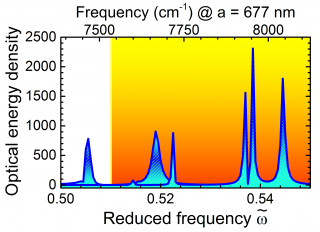
To understand the impact of resonant cavities, we have modeled a point defect inside a 3D photonic band gap crystal with finite support. We find a large electric-field energy enhancement at the cavity resonances. By comparing resonance bands in the band structure for an infinite crystal and troughs in the reflectivity spectra for a finite crystal, we identify cavity resonances and their field patterns. Out of five observed cavity resonances, one is s-polarized and four are p-polarized. These cavity resonances are angle-independent, indicating a strong confinement of light in the crystal slab. We observe Fano resonances below the band gap due to the electromagnetic interference between the discrete contribution of the fundamental cavity mode and the continuum contribution of the light scattered by the photonic crystal. Our results indicate that 3D photonic band gap crystals with resonant cavities are interesting candidates for the absorbing medium of a solar cell in order to enhance the photovoltaic efficiency. Consequently, our analysis of the resonant cavity provides a novel insight in various resonances appearing due to locally disrupted lattice symmetry in 3D periodic photonic nanostructures.
Finally, we have developed a novel solver using the discontinuous Galerkin finite-element method (DGFEM) for the time-harmonic Maxwell equations with periodic dielectric materials. For accurate eigenvalue computations, we have explicitly implemented the divergence constraint.
|