Reflectivity calculated for a three-dimensional silicon photonic band gap crystal with finite support
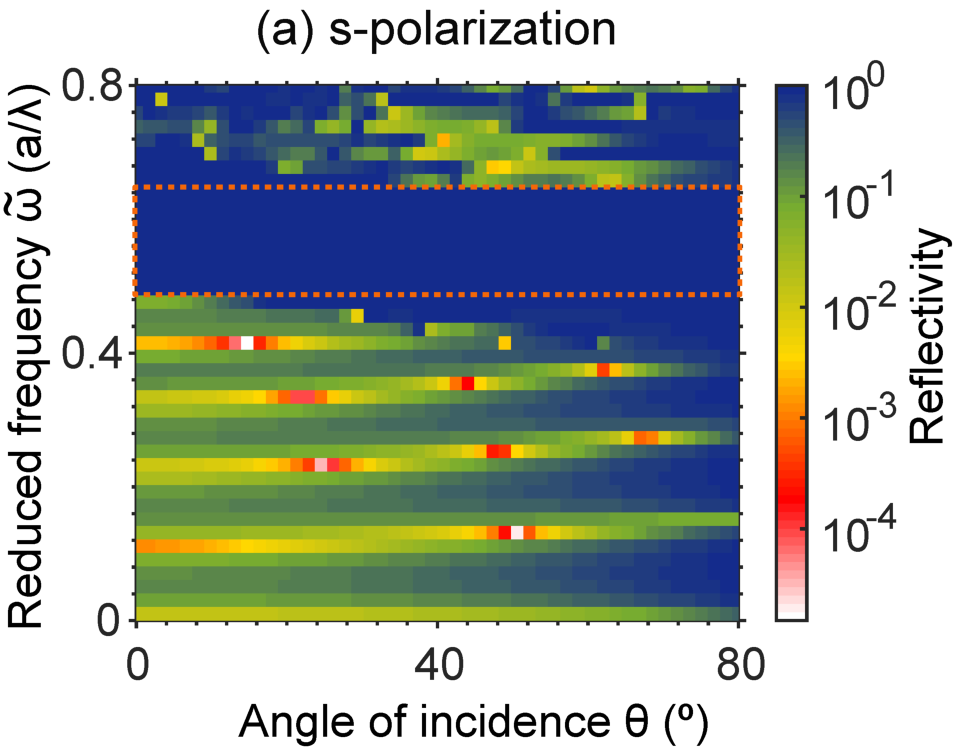
| Abstract | We study numerically the reflectivity of three-dimensional (3D) photonic crystals with a complete 3D photonic band gap, with the aim to interpret recent experiments. We employ the finite element method to study crystals with the cubic diamond-like inverse woodpile structure. The high-index backbone has a dielectric function similar to silicon. We study crystals with a range of thicknesses up to ten unit cells(L≤10c). The crystals are surrounded by vacuum, and have a finite support as in experiments. The polarization-resolved reflectivity spectra reveal Fabry-Pérot fringes related to standing waves in the finite crystal, as well as broad stop bands with nearly 100% reflectivity, even for thin crystals. From the strong reflectivity peaks, it is inferred that the maximum reflectivity observed in experiments is not limited by finite size. The frequency ranges of the stop bands are in excellent agreement with stop gaps in the photonic band structure, that pertain to infinite and perfect crystals. The frequency ranges of the observed stop bands hardly change with angle of incidence, which is plausible since the stop bands are part of the 3D band gap. Moreover, this result supports the previous assertion that intense reflection peaks measured with a large numerical aperture provide a faithful signature of the 3D photonic band gap. The Bragg attenuation length L_B exceeds the earlier estimates based on the width of the stop band by a factor 6 to 9. Hence crystals with a thickness of12 unit cells studied in experiments are in the thick crystal limit (L>> L_B). In our calculations for p-polarized waves, we also observe an intriguing hybridization of the zero reflection of Fabry-Pérot fringe sand the Brewster angle, which has not yet been observed in experiments. |
|---|---|
| URL | |
| Authors | D. Devashish, S. B. Hasan, J. J. W. van der Vegt, and W. L. Vos |
| Year of publication | 2017 |
| Date published | 04/2017 |
| Journal | Phys. Rev. B |
| Volume | 95 |
| Pages | 155141: 1 - 12 |
| Keywords | finite element method, finite size effects, photonic band gap, photoniccrystal, photovoltaics, polarization |