Cartesian light: Unconventional propagation of light in a 3D superlattice of coupled cavities within a 3D photonic band gap
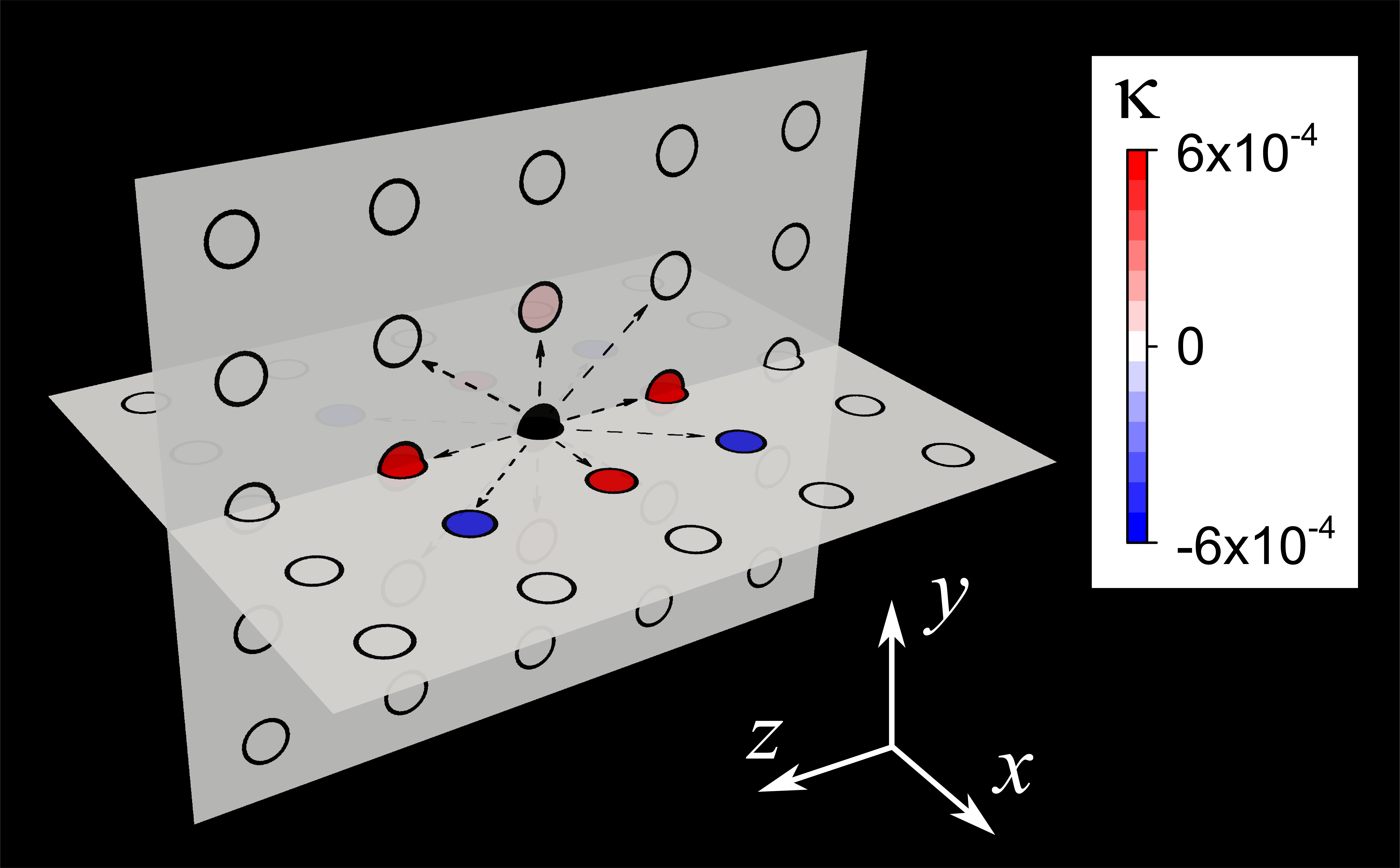
| Abstract | We explore the unconventional propagation of light in a three-dimensional (3D) superlattice of coupled resonant cavities in a 3D photonic band-gap crystal. Such a 3D cavity superlattice is the photonic analog of the Anderson model for spins and electrons in the limit of zero disorder. Using the plane-wave expansion method, we calculate the dispersion relations of the 3D cavity superlattice with the cubic inverse woodpile structure that reveal five coupled-cavity bands, typical of quadrupole-like resonances. For three out of five bands, we observe that the dispersion bandwidth is significantly larger in the (kx, kz )-diagonal directions than in other directions. To explain the directionality of the dispersion bandwidth, we employ the tight-binding method from which we derive coupling coefficients in three dimensions. For all converged coupled-cavity bands, we find that light hops predominantly in a few high-symmetry directions including the Cartesian (x, y, z) directions, therefore we propose the name “Cartesian light.” Such 3D Cartesian hopping of light in a band gap yields propagation as superlattice Bloch modes that differ fundamentally from the conventional 3D spatially extended Bloch wave propagation in crystals, from light tunneling through a band gap, from coupled-resonator optical waveguiding, and also from light diffusing at the edge of a gap. |
|---|---|
| Authors | S. A. Hack, J. J. W. van der Vegt, and W. L. Vos |
| Year of publication | 2019 |
| Date published | 03/2019 |
| Journal | Phys. Rev. B |
| Volume | 99 |
| Pages | 115308: 1-13 |
| DOI number | 10.1103/PhysRevB.99.115308 |
| Keywords | 3D photonic band gap crystals, band structure, confinement, defect, finite-size scaling, superlattice |